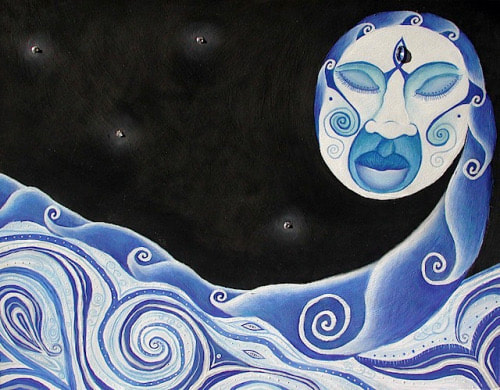
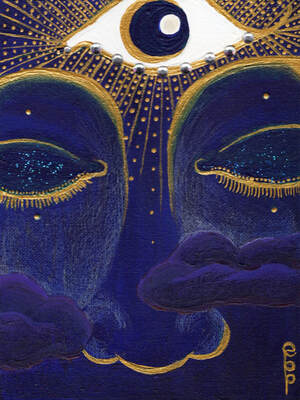
 "Yemaya" 2007 mixed media © Erika Prater A Love Poem I surrender to the wave of Love It knocks me down and rolls me over It gives peace when I release resistance I surrender to the wave of Love After practicing Reiki for a while, many practitioners will begin to feel a common sensation of warm, tingling energy in the palms of their hands. It can be a very exciting experience that personally confirms this unique and unseen, vital energy. This occurrence often happens throughout a hands on healing session and also during meditation practice. After many years, I have found that once the practitioner is present and breathing mindfully, waves of Reiki naturally begin to flow and can actually be felt through the hands. Depending on the condition of the recipient, the flow can start off gentle and then build in relative intensity before winding down, returning to a calmer state. If the practitioner's hands remain where they are after the initial wave has passed, in time another surge of balancing energy often approaches, continuing to address whatever is in need in that particular area. Observing this continuous, dynamic pulse of Reiki throughout healing sessions or meditation practice can be an intriguing experience and is an aspect that continues to draw my interest. It is important to state that while not all practitioners may sense this vital energy in their hands, as long as the practitioner is mindfully present, Reiki is also present and flowing. 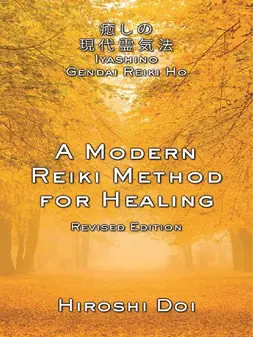 In Hiroshi Doi's excellent book, "A Modern Reiki Method for Healing", the Japanese term Reiha is used to describe a particular wave of energy that is composed of cosmic intelligence. This word is a combination of Rei (Spirit/Cosmic Consciousness) + Hado (wave of energy). Reiha, this wave of spiritual energy that often manifests as warm and tingling physical sensations many practitioners experience in their hands, is the actual flow of Reiki. Throughout my years of practicing, I have heard Reiki at times likened to water, love, and also a gift. These descriptions have resonated and stayed with me as I have also found that Reiki seems to flow harmlessly like cleansing and nourishing water, is unconditional like love and is indeed a beneficent gift for those who receive (and share) it. “Reiki is love,
|
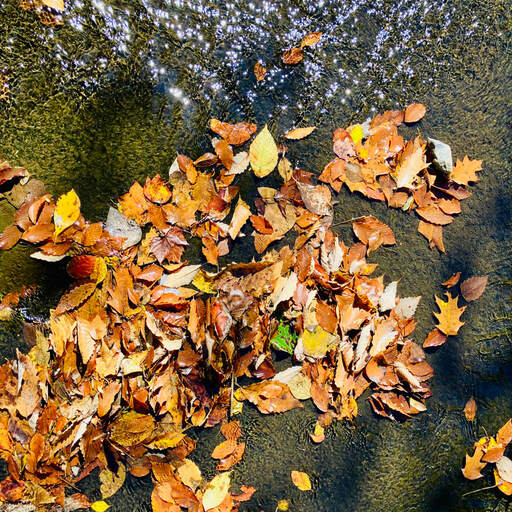
| Before the Northern Hemisphere shifts into the darker, colder time of year, we first move through the brief threshold of equal night and day. Marking the first official day of autumn, the fall equinox can be a special time to meditate on the balance of leaving behind the high energy days of summer and moving toward the lengthy, introspective nights of fall and winter. Growing up in New England, fall has been a favorite season of mine since childhood. As a mythology nerd, learning about the Greek goddess Persephone and her autumnal descent into the underworld every year has always resonated with me. The clay mask on the left was made in honor of her two selves; her young springtime self as Kore "The Maiden", before she finds her way down into the dark, cold Earth as Persephone, a classic queen of the underworld. | 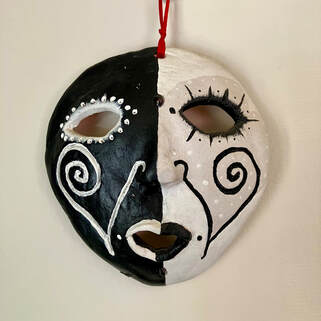 "Persphone Kore" 2009 mixed media mask © Erika Prater At this time, reflecting back at all that has blossomed and come to fruition with gratitude while staying rooted in this energy of release and change, can be a simple act of balance. |
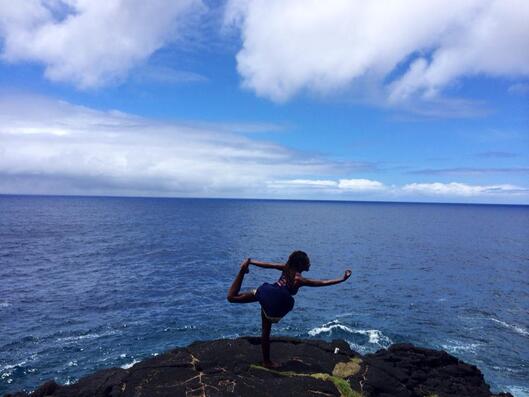
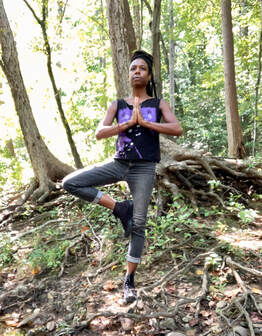 Vrksasana - Tree Pose
 Exploring Tree Pose:
To support yourself in this posture, you're welcome to stand near a wall, chair or some other sturdy object while balancing on one foot. Once you're steady in your tree pose, be sure to find a point across your line of sight to focus on.
Begin standing with both feet about hip distance apart, experiment with finding the right distance that feels the most stable for you. Gently lift your toes and notice the balls and heel of your feet contacting the ground beneath you, root down through these points. Relax your toes back down and sense the inner arches of your feet.
With a sense of playful imagination, feel the energy of the Earth traveling up through the inner arches of your feet, up through your ankles, inner calves and thighs and now the center line of your core. Imagine this midline at the center of your body from the crown of your head to your feet stabilizing you.
With your hands at your hips, take a slow deep breath in, drawing in this Earth energy, let this in breath lengthen your spine - as you breath out, feel your shoulders relax and ground down through the heels and balls of your feet. Without lifting up the other foot, shift your weight to the right foot, then left - ease back and forth to get a sense of your balance and steadiness while remaining grounded.
Begin shifting your weight onto the right foot, when you're feeling stable enough bend your left knee and turn it outwards toward the left, gently opening up your hip on the left side. Lightly contact the ground with the ball of your left foot as you draw your left heel in close to your right ankle. You can remain here in your Tree Pose or let your left foot travel up to your inner calf or thigh (avoid resting your foot at the right knee joint, either place it above or below this area).
Once you've found the right position for your tree, stay rooted and breath for a few moments. Feel free to release your hands from your hips to let your branches travel through the air, maybe over head or perhaps resting at the heart space. Tip: Allow the standing leg's knee to slightly bend for better stability.
When you're ready to try this on the other side, slowly release your left leg back to standing. Take a little pause to breathe and notice any difference in sensation between each leg. Now shift your weight over to the left foot, rooting down through the balls and heel. When you're feeling stable enough, repeat the same steps to grow your tree.
To support yourself in this posture, you're welcome to stand near a wall, chair or some other sturdy object while balancing on one foot. Once you're steady in your tree pose, be sure to find a point across your line of sight to focus on.
Begin standing with both feet about hip distance apart, experiment with finding the right distance that feels the most stable for you. Gently lift your toes and notice the balls and heel of your feet contacting the ground beneath you, root down through these points. Relax your toes back down and sense the inner arches of your feet.
With a sense of playful imagination, feel the energy of the Earth traveling up through the inner arches of your feet, up through your ankles, inner calves and thighs and now the center line of your core. Imagine this midline at the center of your body from the crown of your head to your feet stabilizing you.
With your hands at your hips, take a slow deep breath in, drawing in this Earth energy, let this in breath lengthen your spine - as you breath out, feel your shoulders relax and ground down through the heels and balls of your feet. Without lifting up the other foot, shift your weight to the right foot, then left - ease back and forth to get a sense of your balance and steadiness while remaining grounded.
Begin shifting your weight onto the right foot, when you're feeling stable enough bend your left knee and turn it outwards toward the left, gently opening up your hip on the left side. Lightly contact the ground with the ball of your left foot as you draw your left heel in close to your right ankle. You can remain here in your Tree Pose or let your left foot travel up to your inner calf or thigh (avoid resting your foot at the right knee joint, either place it above or below this area).
Once you've found the right position for your tree, stay rooted and breath for a few moments. Feel free to release your hands from your hips to let your branches travel through the air, maybe over head or perhaps resting at the heart space. Tip: Allow the standing leg's knee to slightly bend for better stability.
When you're ready to try this on the other side, slowly release your left leg back to standing. Take a little pause to breathe and notice any difference in sensation between each leg. Now shift your weight over to the left foot, rooting down through the balls and heel. When you're feeling stable enough, repeat the same steps to grow your tree.
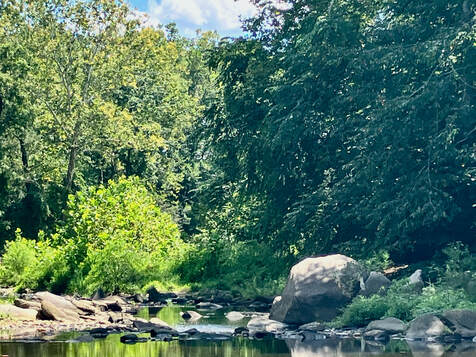
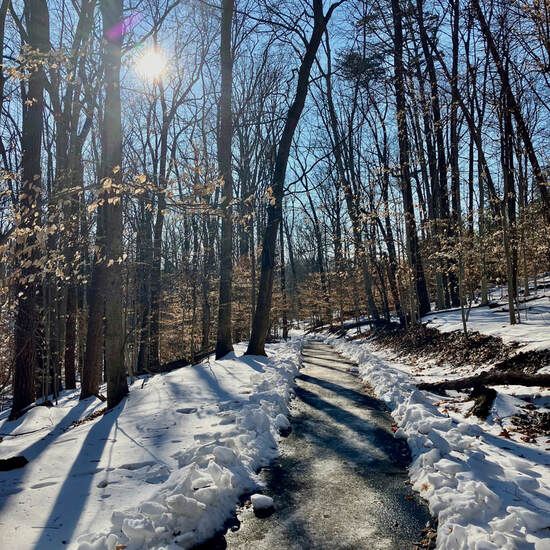
Taking a walk through nature is an effortless way to refresh the mind and body; here we are fully surrounded by peaceful, vital energy emanating from the natural world, often bringing us back to a more whole, balanced state of being.
I like to describe vital energy as that spark of life that exists throughout all of creation, animate or inanimate; from rain drops to blades of grass, sunlight to a maple leaf, or a grain of sand to a human being. All of creation can be seen as touched by this vital energy, supporting and nourishing that particular form of existence.
Wherever you are, whether visiting a local park or at home in your room, you have the opportunity to cultivate and circulate healing, vital energy through your system. Eastern practices such as Yoga and Tai Chi work with circulating this energy in their own unique way. In Yoga's homeland of India, this energy is called Prana, and yogic breathing techniques like pranayama directly work with regulating and balancing prana or vital energy throughout the phsyical and subtle body. The Chinese martial art of Tai Chi also works with the flow of vital energy aka Chi via slow, mindful breath and movement.
Japan's healing system of Reiki continues this thread with it's own meditative techniques that support our Ki, the Japanese term for vital energy. Hikari No Kokyu Ho (breathing in the light method) is a Japanese healing practice that helps promote the generation and expansion of Ki through focused breathwork and visualization. It is a traditional Reiki practice originally taught by founder, Mikao Usui, to his students to help them keep the flow of vital energy strong in their system. This technique is still taught and in use among modern day Reiki practitioners for the same purpose.
Even if you are not an attuned Reiki practitioner, you still have access to your own flow of vital energy and the ability to support it. Practicing Hikari No Kokyu Ho is a great form of self care and can benefit anyone who wishes to tune into their Ki.
I like to describe vital energy as that spark of life that exists throughout all of creation, animate or inanimate; from rain drops to blades of grass, sunlight to a maple leaf, or a grain of sand to a human being. All of creation can be seen as touched by this vital energy, supporting and nourishing that particular form of existence.
Wherever you are, whether visiting a local park or at home in your room, you have the opportunity to cultivate and circulate healing, vital energy through your system. Eastern practices such as Yoga and Tai Chi work with circulating this energy in their own unique way. In Yoga's homeland of India, this energy is called Prana, and yogic breathing techniques like pranayama directly work with regulating and balancing prana or vital energy throughout the phsyical and subtle body. The Chinese martial art of Tai Chi also works with the flow of vital energy aka Chi via slow, mindful breath and movement.
Japan's healing system of Reiki continues this thread with it's own meditative techniques that support our Ki, the Japanese term for vital energy. Hikari No Kokyu Ho (breathing in the light method) is a Japanese healing practice that helps promote the generation and expansion of Ki through focused breathwork and visualization. It is a traditional Reiki practice originally taught by founder, Mikao Usui, to his students to help them keep the flow of vital energy strong in their system. This technique is still taught and in use among modern day Reiki practitioners for the same purpose.
Even if you are not an attuned Reiki practitioner, you still have access to your own flow of vital energy and the ability to support it. Practicing Hikari No Kokyu Ho is a great form of self care and can benefit anyone who wishes to tune into their Ki.
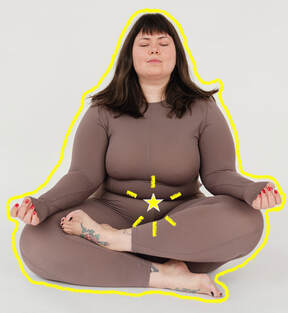 Breathing in the light | In this practice we begin in a comfortable seated position, making sure to have back support if needed while sitting upright. Hands can lay in your lap, palms open and relaxed. Give yourself some time to relax and settle in, developing a natural, easy, and steady pace of breath. Tune into your center of vitality, the Hara (abdomen), located about 3 finger widths below your navel (see the yellow star in left image). As you breathe in - preferably through the nose, draw your breath down to the hara. If it helps, you may visualize this breath as light entering through the nose or crown of the head and gathering below at the lower belly/hara. As you exhale, visualize this light energy expanding out through your core and into the external world around you. Continue breathing with this imagery at a slow and comfortable pace. If visualization does not work for you, try exploring your other senses such as sound or sensation to get a better feel for how you may experience breathing with vital energy. |
Hikari No Kokyu Ho can be practiced on a daily basis from 5 to 30 minutes. If you're new to meditative practices, it's best to go easy on yourself and start off with a shorter seated practice (5 minutes will do).
As you explore this focused meditation practice, take note of how it affects your state of being mentally, emotionally, physically, and even spiritually if you are open to it. Give yourself the time and space to process and integrate your experiences with reflective exercises like journaling, unplugging from social media, etc.
I find that while navigating through these challenging and unprecedented times, having these tools to ground and center has been so valuable for my own sense of balance. I hope you find value in them as well <3
As you explore this focused meditation practice, take note of how it affects your state of being mentally, emotionally, physically, and even spiritually if you are open to it. Give yourself the time and space to process and integrate your experiences with reflective exercises like journaling, unplugging from social media, etc.
I find that while navigating through these challenging and unprecedented times, having these tools to ground and center has been so valuable for my own sense of balance. I hope you find value in them as well <3
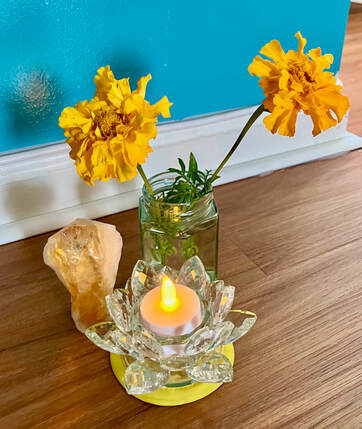
summer solstice altar for today’s gentle yoga class
what has come full bloom
encouraged by the moon
and the north climbing sun
standing still soon
fiery dreams planted
quiet dark within
first rooted, then sprouted
now unraveling...
a sparkling light
wild shining Source
sweet rhythms of creation
echoing endlessly forth
<3
by E. Prater
encouraged by the moon
and the north climbing sun
standing still soon
fiery dreams planted
quiet dark within
first rooted, then sprouted
now unraveling...
a sparkling light
wild shining Source
sweet rhythms of creation
echoing endlessly forth
<3
by E. Prater
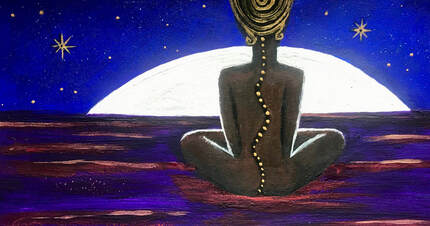 "Moon Meditation" 2021 mixed media © Erika Prater
Yoga Citta Vritti Nirodhah
"Yoga is the cessation of the fluctuations of the mind."
Yoga Sutra 1.2
The daily whirlwind of thoughts and internal dialogue that our minds naturally engage in, are these "fluctuations" the practice of Yoga aims to bring into peace and stillness. Practicing meditation is like flexing a mental muscle. Every time we become aware of being distracted, and respond by gently returning our focus to the breath and present moment, the gentle muscle of awareness becomes stronger and more capable. This can serve us very well in times of great stress and tension.
Boredom, irritation, and general distraction are all common and normal experiences when beginning to practice sitting with the mind. At these times, it is helpful to be clear on your intention and allow it to inspire you to continue and breathe with the mental discomfort*. It is also helpful to remember that the mind is naturally a thought factory. Practicing meditation is not about completely clearing the mind of thoughts, but rather observing thoughts without attachment and overwhelm.
Daily, committed practice - no matter how short the length of time, will eventually yield beneficial results for the mind. The more we become familiar with being in the present moment, the easier it is to find in times of need. In my own experience as someone with anxiety, after over three years of exploring a daily meditation practice, it has certainly become easier for me to feel more present and less reactive in stressful situations. Practicing meditation cultivates equanimity; remaining anchored in one's center while navigating the inevitable ups and downs of life.
If you're curious to try out a self guided, breath focused meditation, here are some tips:
When I first began my meditation practice, I eased myself in by starting off with only sitting for 5 minutes. As weeks or months passed, I would gradually add on another 5 minutes to slightly lengthen my practice. I recommend starting off in a similar way for folks who are just beginning to explore self-guided meditation. The most ideal time and place for your practice is based on your own routine and schedule, it truly varies for everyone. If time allows, you may want to integrate and reflect on your experience by journaling.
Yoga constantly reveals the connection between the breath and mind. With practice, the fluctuations of the mind follow the breath to a more calm and balanced state of being. Whether seated in meditation or moving through asana, an easeful and steady pace of breath will support an easeful and steady mind, vice versa.
Please be gentle with yourself as you begin to explore sitting in silence with your mind, it can definitely be as challenging as it is simple...perhaps keep in mind these inspiring words from the Tao Te Ching:
Boredom, irritation, and general distraction are all common and normal experiences when beginning to practice sitting with the mind. At these times, it is helpful to be clear on your intention and allow it to inspire you to continue and breathe with the mental discomfort*. It is also helpful to remember that the mind is naturally a thought factory. Practicing meditation is not about completely clearing the mind of thoughts, but rather observing thoughts without attachment and overwhelm.
Daily, committed practice - no matter how short the length of time, will eventually yield beneficial results for the mind. The more we become familiar with being in the present moment, the easier it is to find in times of need. In my own experience as someone with anxiety, after over three years of exploring a daily meditation practice, it has certainly become easier for me to feel more present and less reactive in stressful situations. Practicing meditation cultivates equanimity; remaining anchored in one's center while navigating the inevitable ups and downs of life.
If you're curious to try out a self guided, breath focused meditation, here are some tips:
- Location: A relatively quiet/distraction free space
- Seating: Sitting comfortably upright is ideal. Using a chair or cushion with a wall for back support is fine
- Intention: Be clear or curious on your purpose for exploring meditation today
- Practice: Remain focused on the breath; count it, feel it, or visualize it, & gently return to it when distracted
- Time Length: Practice time can range from 1-15 minutes, whatever amount you have available in your day
- Integration: As you move into your next activity, allow the calm and mindfulness to remain with you
When I first began my meditation practice, I eased myself in by starting off with only sitting for 5 minutes. As weeks or months passed, I would gradually add on another 5 minutes to slightly lengthen my practice. I recommend starting off in a similar way for folks who are just beginning to explore self-guided meditation. The most ideal time and place for your practice is based on your own routine and schedule, it truly varies for everyone. If time allows, you may want to integrate and reflect on your experience by journaling.
Yoga constantly reveals the connection between the breath and mind. With practice, the fluctuations of the mind follow the breath to a more calm and balanced state of being. Whether seated in meditation or moving through asana, an easeful and steady pace of breath will support an easeful and steady mind, vice versa.
Please be gentle with yourself as you begin to explore sitting in silence with your mind, it can definitely be as challenging as it is simple...perhaps keep in mind these inspiring words from the Tao Te Ching:
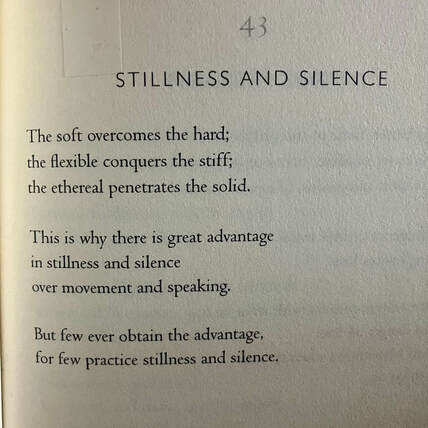
translation by Dwight Goddard
*Though many folks do benefit from mindfulness practices, some who live with PTSD may run into difficulties during their inner explorations. Past trauma that has yet to be fully processed and integrated may come to the surface as the mind becomes more settled and quiet. Depending on the severity, it is best to stop the mindfulness practice and seek help from a qualified professional that is also a mindfulness practitioner. After the challenges have been integrated, a meditation/mindfulness practice can be resumed when it is safe enough to do so.
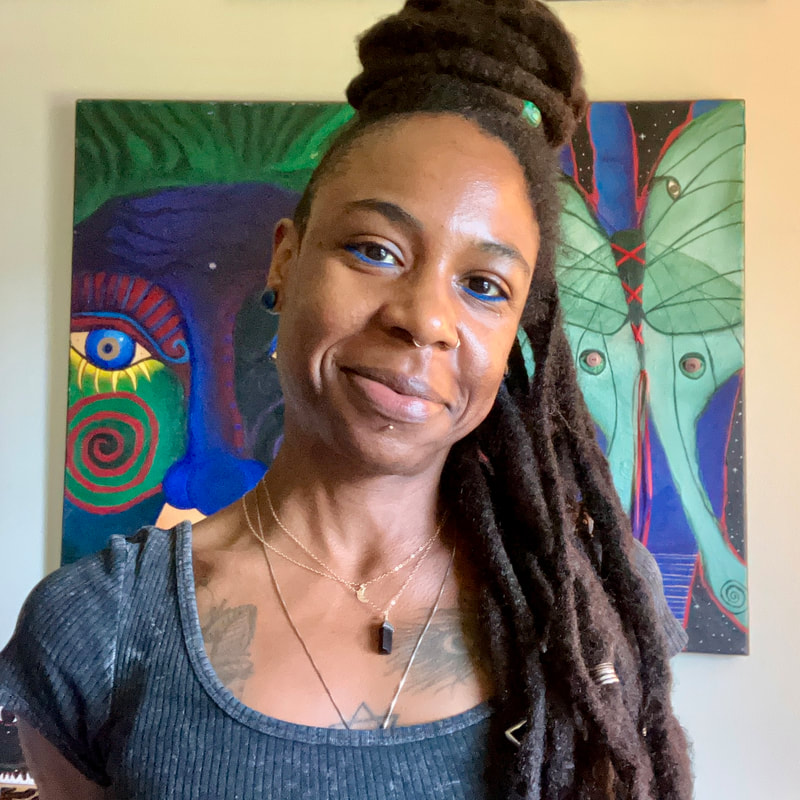
Author
Hi, I'm Erika Prater, a wellness practitioner and mixed media artist.
This is where I happily weave together creative expression and spiritual aspects of the healing arts.
Enjoy! <3
Archives
December 2025
November 2025
October 2025
September 2025
August 2025
June 2025
May 2025
 RSS Feed